The essentials
- 1The assessment under § 23 StVZO is reserved to officially recognised experts, examiners and test engineers; the independent valuation report is not.
- 2§ 2 number 22 FZV names four requirements that must be met alongside one another; the age of 30 years alone does not carry the classification.
- 3The Classic Data condition grade and the good preserved condition of the Vehicle Registration Regulations are different yardsticks and must not be equated.
- 4Absolute paint thicknesses from modern series production transfer only to a limited extent to classic vehicles; the comparison within the same vehicle remains defensible.
Classifying a vehicle as historic and determining its value are two separate tasks with different legal bases, different issuing competences and different yardsticks for the same word: condition. An expert who mixes both tasks in one document delivers a paper that carries for neither.
Two Documents That Are Routinely Confused
An instruction to carry out a classic vehicle appraisal can mean two fundamentally different documents. Clarifying which one is meant belongs at the start of the engagement, not in the closing discussion. One is the assessment under § 23 of the German Road Traffic Licensing Regulations (StVZO), by which a vehicle is classified as a historic vehicle and through which the H registration becomes accessible. The other is an independent valuation report that establishes a value as at a given valuation date and is needed for insurance, the division of an estate, financing or a sale.
The difference is not a formality but a question of competence. § 23 StVZO provides that classifying a vehicle as a historic vehicle within the meaning of § 2 number 22 of the Vehicle Registration Regulations (FZV) requires a report by an officially recognised expert, examiner or test engineer. The assessment must follow a guideline published in the Verkehrsblatt, and the report must be issued using a template laid down in that guideline. In addition, an inspection equivalent in scope to a periodic technical inspection under § 29 StVZO must be carried out as part of the assessment, unless a report under § 21 StVZO is produced at the same time.
This restriction does not apply to the independent valuation report. It is bound to no official template and is open to any qualified independent expert. Nor, however, does it confer an H registration. An expert who supplies a valuation report to a client who actually needed the classification has worked past the requirement. Conversely, anyone who labels a document an assessment under § 23 StVZO without holding official recognition is issuing something that cannot have the intended effect.
| Feature | Assessment under § 23 StVZO | Independent valuation report |
|---|---|---|
| Purpose | Classification as a historic vehicle, basis for the H registration | Establishing a value as at a defined valuation date |
| Who may issue it | officially recognised expert, examiner or test engineer | qualified expert, no official recognition prescribed |
| Form | template under the guideline published in the Verkehrsblatt | freely structured, professionally reasoned |
| Scope of inspection | additionally an inspection equivalent in scope to a periodic technical inspection under § 29 StVZO | survey at the expert's professional discretion |
What § 2 Number 22 FZV Actually Requires
The Vehicle Registration Regulations define a historic vehicle in § 2 number 22 as a vehicle that, at the time of its assessment as a historic vehicle, first entered service at least 30 years ago, largely corresponds to its original condition, is in good preserved condition and serves the cultivation of motor vehicle technical heritage. Four requirements that must be met alongside one another. Age alone does not carry the classification.
Two details of the wording are overlooked in practice. First, the period is tied to the time of the assessment, not to the date of the application or of registration. Second, the text says largely corresponding to the original condition, not exclusively. The provision does not require a reconstruction of the ex-works condition, but the absence of modifications that remove the vehicle's original character.
- First entry into service at least 30 years ago, measured against the time of assessment
- Largely corresponding to the original condition
- Good preserved condition as an independent criterion, separate from age
- Suitability for the cultivation of motor vehicle technical heritage
For the survey this implies a clear order of work. The date of first registration is master data taken from the registration certificate and verified in seconds. Original condition and preserved condition, by contrast, are findings that must be established assembly by assembly and evidenced individually. An expert who affirms them in the aggregate has treated the three demanding requirements with the care appropriate to the simple one.
The Condition Grade as the Anchor of the Valuation
The condition grades from 1 to 5 introduced by Classic Data have become the descriptive standard for classic vehicles. Grade 1 denotes a flawless, completely and impeccably restored vehicle with no defects or signs of wear. Grade 2 stands for a vehicle that is technically and visually free of defects with slight signs of use, which must bear a reasonable relationship to the mileage or to the time elapsed since restoration. Grade 3 describes a roadworthy vehicle in running order without major technical or visual defects. Grade 4 denotes a vehicle of only limited roadworthiness, which as a rule requires immediate repairs to pass a periodic technical inspection. Grade 5 stands for a poor, non-roadworthy overall condition with work required in almost all assemblies. Intermediate grades such as 2- or 3+ are customary.
The grade is the result of the survey, not its starting point. If it is awarded first and the findings are then worded to fit, the resulting document falls apart at the first cross-examination: the grade then stands for nothing that was demonstrably recorded in the report. The defensible order is capture, individual finding, overall appraisal, grade.
The condition grade and the good preserved condition under § 2 number 22 FZV are two different yardsticks and must not be equated. The condition grade is a privately developed descriptive framework for valuation purposes. Preserved condition is a legal term of the Vehicle Registration Regulations, decided upon in the course of the assessment under § 23 StVZO. An expert who infers eligibility for classification as a historic vehicle from a condition grade is transferring a yardstick into a context for which it was not devised.
Measuring the Preserved Condition Instead of Estimating It
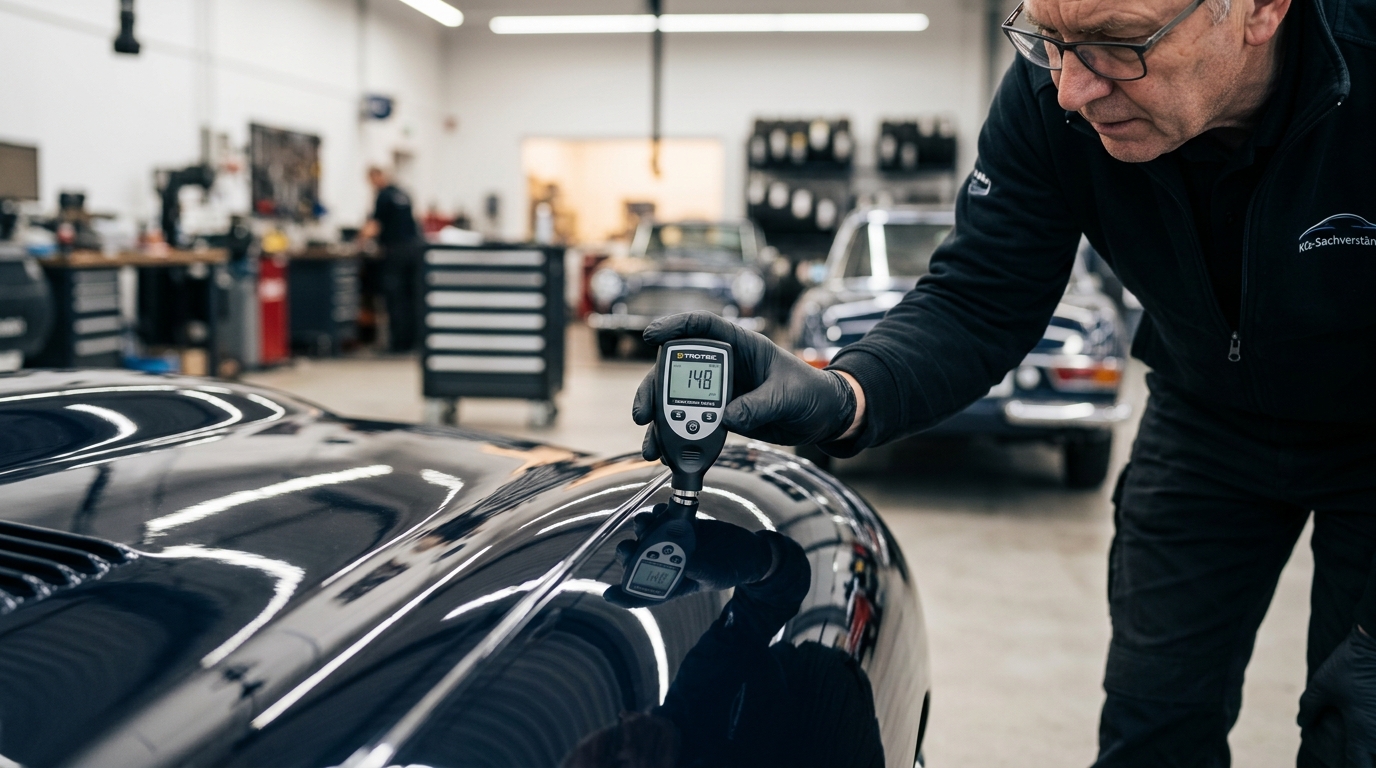
Preserved condition is the part of the valuation that can most readily be supported by measurable findings, and the part most frequently estimated in practice. The DIAVAG vehicle capture profile carries fields with stored expectations for this area: paint thickness in micrometres, paint condition, corrosion in the grades none, surface rust and rusted through, visible accident traces, respray, panel gaps as well as tread depth and tyre age.
For paint thickness a qualification is required that belongs in the report. The expectation stored in the profile of 80 to 160 micrometres for factory paintwork, above 200 micrometres as an indication of respray and above 300 micrometres as an indication of filler derives from modern series production. On a vehicle painted decades before that manufacturing practice, the absolute reading carries only limited meaning. What remains defensible is the comparison within the same vehicle: where a single panel deviates markedly from the others, that is a finding, irrespective of the absolute level of the factory paintwork.
- Take readings at several points per panel, not one reading per side of the vehicle
- Record deviations between panels as a finding, not as an incidental remark
- Name the origin of every value: measuring instrument, visual inspection or client statement
- State expressly in the report that modern expectation values transfer only to a limited extent
The same principle applies to corrosion. The distinction between surface rust and rusted through is not a nuance of language but the difference between cosmetic effort and load-bearing substance. It must be decided at the vehicle and documented per location, not assigned in the aggregate for the vehicle.
Documenting Originality Without Asserting It
Originality is a finding about individual assemblies and not a property of the vehicle as a whole. A report that speaks in general terms of an original vehicle says nothing in professional substance. What is defensible is the schedule of which assemblies are regarded as original, what that assessment rests on, and which assemblies have visibly been replaced, reworked or cannot be attributed.
The identification features form the basis here because they do not change over time: the vehicle identification number, the date of first registration from the registration certificate and, where present and legible, the numbers on engine and gearbox. These entries are master data and remain verifiable unchanged years later. Everything beyond them is an appraisal and belongs marked as such.
A recurring conflict of objectives concerns the tyres. Under ECE-R30, tyres carry an embossed date of manufacture; since the year 2000 the code has been four digits and states the week and year of production, before that it was three digits. Period-correct tyres on a classic vehicle are therefore frequently so old that they must be assessed critically irrespective of the remaining tread depth. At the same time, § 36 paragraph 3 StVZO requires a tread depth of at least 1.6 millimetres for the main tread pattern around the entire circumference. Both findings belong side by side in the survey; setting them off against one another is not the expert's task.
The Valuation Date and Market Observation
A valuation without a named valuation date is incomplete. The condition is documented for a particular day, the market situation is drawn on for that same day, and the two belong visibly brought together in the report. With classic vehicles this matters more than in current used vehicle business, because market movement is tied more closely to individual models and equipment variants and cannot be derived from a general index.
The comparable objects on which the valuation rests must be named and their comparability reasoned. This includes how the vehicle being valued differs from the objects drawn on and how that difference was accounted for in the result. An addition or deduction whose derivation is not in the report cannot be defended in a dispute.
- Name the valuation date expressly and use it consistently for condition and market situation
- List the comparable objects drawn on individually and reason their comparability
- Show every correction to the starting value separately and disclose its derivation
- Record the data source for each comparable object so that it remains findable later
What Carries the Valuation in a Dispute
A classic vehicle valuation report is rarely challenged on the day it is produced, but months or years later, when an insured event occurs or the division of an estate becomes contentious. What counts then is not how extensive the report was, but whether it can be said of every finding what it rests on. That applies to the condition grade as much as to each individual correction to the starting value. An expert who documents that connection from the outset is working to the principle we have described elsewhere as source binding.
Two organisational points decide more here than skill in wording. First, it must remain traceable who reviewed and approved which version and when; a documented approval trail answers that question years later without reconstruction from memory. Second, the raw data must be preserved: measurement records, photographs with capture times and the evidence for the comparable objects. Without them, all that is left of the report is its final version, and that does not support itself.
DIAVAG provides the software with which experts capture on site, review the draft and deliver under their own brand. Professional responsibility for every finding and for the valuation remains with the signing expert. How that responsibility is delimited from the question of tooling we examined in more detail in connection with the EU AI Act. For the requirements of a court-proof report they apply unchanged.
Frequently asked questions
- May an independent expert produce a classic vehicle report under § 23 StVZO?
- No. For classification as a historic vehicle, § 23 StVZO requires a report by an officially recognised expert, examiner or test engineer. A qualified independent expert may produce an independent valuation report, but it does not lead to classification and therefore not to the H registration.
- From when does a vehicle count as a historic vehicle?
- Under § 2 number 22 of the Vehicle Registration Regulations it must have first entered service at least 30 years before the time of its assessment as a historic vehicle. Three further requirements are added: largely corresponding to the original condition, a good preserved condition and suitability for the cultivation of motor vehicle technical heritage.
- Does the condition grade replace the assessment of preserved condition?
- No. The condition grade from 1 to 5 is a descriptive framework for valuation. Good preserved condition is a term of the Vehicle Registration Regulations, decided upon in the course of the assessment under § 23 StVZO. Eligibility for classification as a historic vehicle cannot be derived from the grade.
- How should paint thickness be assessed on a classic vehicle?
- The usual expectation values derive from modern series production and transfer only to a limited extent to older painting methods. What remains meaningful is the comparison of readings within the same vehicle: where one panel deviates markedly from the others, that is a finding and belongs documented.
- How should period-correct but aged tyres be handled?
- Both findings belong side by side in the survey. Under ECE-R30 tyres carry an embossed date of manufacture, four digits since the year 2000 stating the week and year of production. Independently of that, § 36 paragraph 3 StVZO requires at least 1.6 millimetres of tread depth for the main tread pattern. The expert documents both and does not set them off against one another.
We'll get in touch with you personally.
No newsletter, no mailing list: sign up if you'd like to learn more about the platform — we'll reach out to you directly.