You don't know the vehicle.
When buying used, you rely on what the seller tells you. Hidden prior damage, a concealed accident, a weak battery: much of this you won't spot on a test drive. An appraisal closes that gap, but only if it holds up.
You want to buy a used car or electric vehicle, and the seller presents an appraisal. Good. But an appraisal is only worth as much as you can read from it. This guide shows what to look for, which measurements matter and how to verify authenticity before you sign.
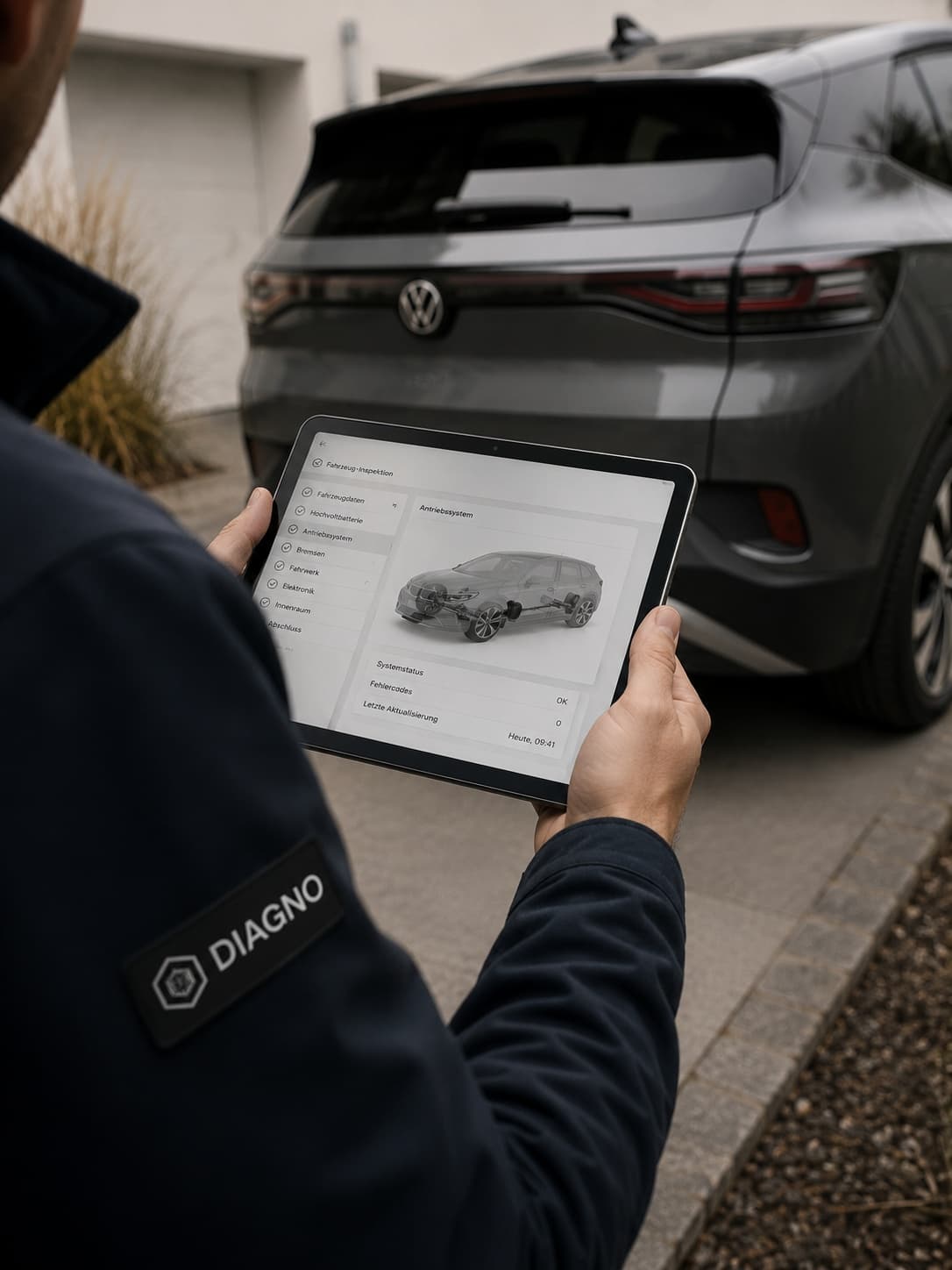
When buying used, you rely on what the seller tells you. Hidden prior damage, a concealed accident, a weak battery: much of this you won't spot on a test drive. An appraisal closes that gap, but only if it holds up.
A condition report without measurements, a document with no identifiable author or an edited PDF is no basis for a purchase decision. Those who don't know what to look for read right past the weaknesses.
Without documented findings, you have no leverage. A verifiable appraisal shifts the negotiation onto equal footing: it shows in black and white what the vehicle is worth and what isn't right.
You don't need to be an appraiser to assess a report. Work through the following points one by one. The more of them are met, the more the document supports your purchase decision.
Check whether a named vehicle appraiser stands behind the document and on whose behalf it was created. An appraisal commissioned by the seller themselves may well be correct, but it warrants a second look at the evidence.
Good appraisals support their findings with photos and measurements. Watch for whether claims like "accident-free" or "good condition" come with verifiable evidence, or whether they remain mere phrases.
Paint coating thickness, tread depth, fault memory, and for an electric car the battery health: these values make the condition comparable. If they're missing, you don't know what was actually inspected.
Check the date and mileage at the time of the inspection. An appraisal from a year ago says little about today's condition, especially for high-mileage drivers and electric vehicles.
PDF files can be edited. Ask for a way to verify authenticity: with portal appraisals this works via a QR code or verification link that shows the version released by the appraiser.
A sound appraisal names repaired prior damage and puts it in context instead of leaving it out. Cross-check the details against the service booklet, invoices and what the seller tells you.
Before the viewing, ask the seller for the complete appraisal, not just a summary. With portal appraisals, shared access is enough.
Establish which appraiser released the report and verify its authenticity before you invest time in the details.
Compare measurements, photos and listed defects with the vehicle in front of you. Discrepancies are questions for the seller.
Documented findings are your basis for negotiation. If something doesn't add up, negotiate the price or walk away.
More and more appraisers deliver their reports not as a PDF attachment but through a client portal. For you as a prospective buyer, that's an advantage: the six points from the guide can be checked there in minutes. Every statement in the text is tied to its corresponding photo or measurement, and you verify authenticity via a QR code or verification link against the version released by the appraiser.
Whatever stays unclear, you resolve in the portal itself: an AI chat answers questions of understanding drawn from the content of the appraisal, and for anything beyond that you can reach the appraiser directly. We show what this looks like from the recipient's perspective on the page for owners.
On the owners page we show what you can view in the portal, how the AI chat answers questions from the appraisal and how the authenticity check works.