The essentials
- 1DIN EN ISO 2178:2016-11 describes the magnetic method for non-magnetic coatings on magnetic substrates; on aluminium the eddy-current method under DIN EN ISO 2360:2017-12 applies instead. The method belongs next to the micrometre value as its source.
- 2§ 36(3) StVZO requires a tread depth of at least 1.6 mm on the main grooves; for mopeds, light mopeds and light motorcycles 1 mm suffices. The reference to 3 mm in the capture field is a recommendation, not a rule.
- 3Battery Regulation (EU) 2023/1542 defines state of health in Article 3(28) and, under Article 14, has required since 18 August 2024 that the battery management system hold up-to-date data on it; from 18 February 2027 the battery passport under Article 77 is added.
- 4Euro 7 Regulation (EU) 2024/1257 sets, in Annex II for M1 passenger cars, minimum values of 80 % of battery energy up to 5 years or 100 000 km and 72 % up to 8 years or 160 000 km; it applies from 29 November 2026 to new types and from 29 November 2027 to all new vehicles.
A reading in a report is only as reliable as the note beside it: what it was measured with, by which method, against which limit. The three values that appear most often in condition reports have three different kinds of anchor. For paint thickness it is a measurement standard, for tread depth a legal provision with a limit, for the battery's state of health a body of rules that first defines the quantity and then regulates access to it. This article places the three side by side, without a single monetary amount.
Three numbers, three kinds of anchor
Anyone appraising a vehicle enters three readings in the capture profile that are later questioned most often: the paint thickness, the tread depth and, for electric and hybrid vehicles, the state of health of the traction battery. All three are numbers with a unit, and all three are worthless without the note beside them. The difference lies in what that note is in each case.
For paint thickness there is no statutory limit. There is a standardised measurement method, and the meaning of the value depends on whether it was applied and on what substrate. For tread depth it is the other way round: measuring is trivial, but the limit is set in a legal provision, and the provision also defines where to measure. For the battery's state of health, finally, there was until recently neither a uniform method nor a binding definition; both are only now emerging through two EU regulations, and anyone reading the value off a tester needs to know what they are reading.
In DIAVAG's vehicle capture profile the three quantities are separate fields with unit and source: paint thickness in µm, tread depth as the lowest measured value in mm, and battery SoH in per cent. Each field carries an expectation hint. That hint is an orientation for capture and expressly not a standard; what belongs in the report as the source is set out in the following sections.
Paint thickness: the method is the source
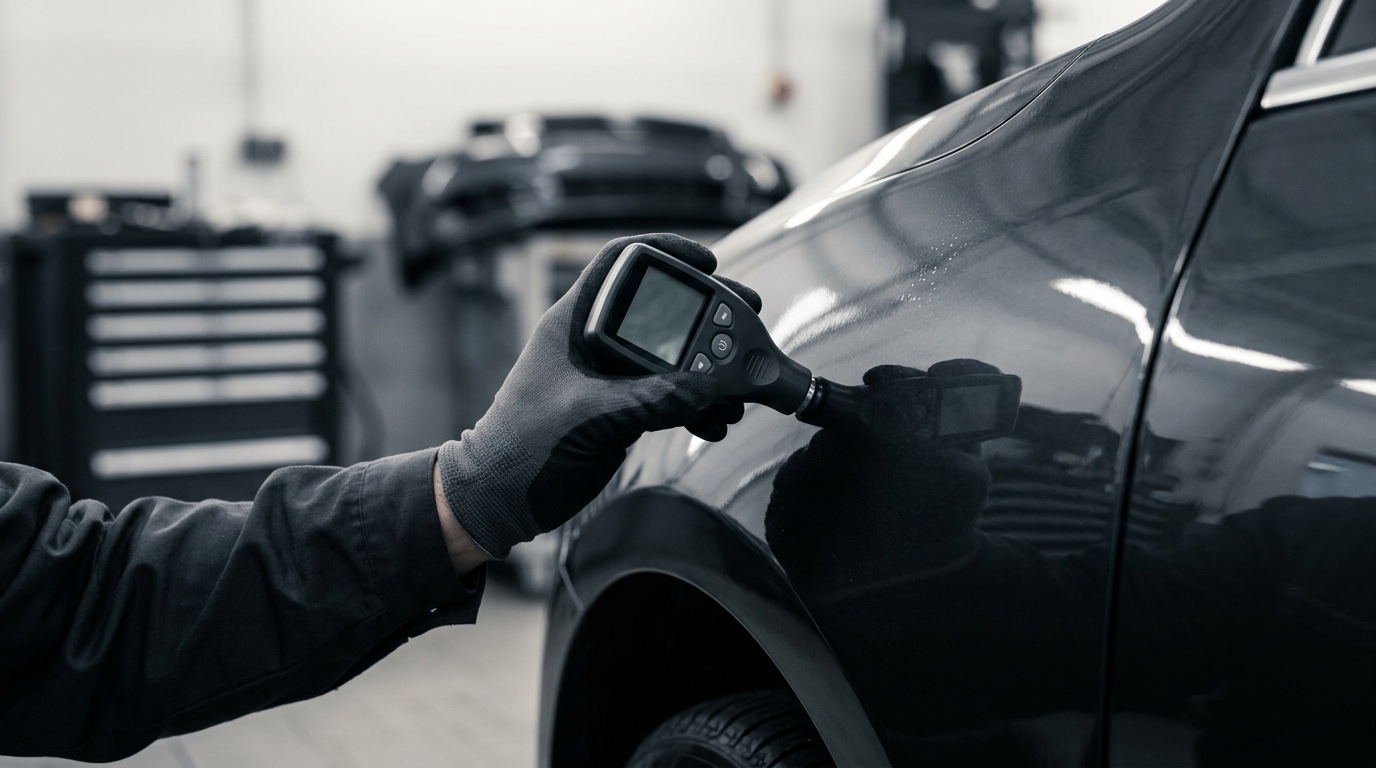
Paint thickness is measured non-destructively, and the method for it is standardised. DIN EN ISO 2178:2016-11 “Non-magnetic coatings on magnetic substrates – Measurement of coating thickness – Magnetic method” describes, according to DIN Media, a method for non-destructive measurements of the thickness of non-magnetisable coatings on magnetisable base metals. The measurement is tactile: the probe or an instrument with integrated probe is placed directly on the coating, and the instrument displays the thickness. Paints and varnishes expressly count as coatings. The 2016 edition replaces the version of April 1995.
The substrate decides the method. The magnetic method presupposes a magnetisable base metal, that is, steel panels. On aluminium parts – bonnets, wings and tailgates of many model ranges – it does not work; there DIN EN ISO 2360:2017-12 “Non-conductive coatings on non-magnetic electrically conductive base metals – Measurement of coating thickness – Amplitude-sensitive eddy-current method” applies. If an instrument masters both methods, it selects according to the substrate; in the report the value is accompanied by a note of which method was used on which part. On plastic parts neither method yields a comparable value, as we described using the motorcycle in our article on the vehicle capture profile on a two-wheeler.
There is no statutory limit. The field in the vehicle profile shows as its expectation hint “Factory 80–160 µm · > 200 resprayed · > 300 filled”. That is an orientation from capture practice, not a standard, and it is to be treated as such: the statement “resprayed” is reliable not because a value exceeds a threshold, but because it deviates from the other panels of the same vehicle. For classic vehicles this applies with greater force; we set out the reservation in the article on classic vehicle valuation. The field catalogue carries one coating-thickness field; values per panel can be created as added fields, and the note names panel and method.
Tread depth: the limit is in § 36(3) StVZO
For tread depth the anchor is a legal provision. § 36(3) StVZO reads, in the part relevant here: “Pneumatic tyres on motor vehicles and trailers must be provided with tread grooves or sipes over the whole circumference and the whole width of the tread. The main tread must have a depth of at least 1.6 mm over the whole circumference; the main tread is the wide grooves in the central area of the tread, which occupies approximately 3/4 of the tread width. For mopeds, light mopeds and light motorcycles, however, a tread depth of at least 1 mm suffices.”
The provision thus regulates three things, all of which should appear in the report. First, the limit of 1.6 mm. Second, the place of measurement: the main tread, that is, the wide grooves in the central area occupying roughly three quarters of the tread width, and over the whole circumference. A single reading at the shoulder says nothing about the provision. Third, the exception of 1 mm for mopeds, light mopeds and light motorcycles.
The vehicle profile provides the field “Tread depth (min.)” in mm, designed as the lowest measured value, with the expectation hint “Legal min. 1.6 mm – recommended ≥ 3 mm”. The 3 mm are a widespread recommendation, not a rule, and should be marked as a recommendation in the report if they are mentioned at all. Anyone measuring per wheel enters the lowest value in the catalogue field and the four individual values in added fields or the note; a report that names only the minimum is evidenced in line with the provision, but not complete without the distribution. The neighbouring field for tyre age via the embossed date code carries its own expectation hint; that too is a rule of thumb and not a regulation for passenger cars.
State of health: a quantity that is only now being defined
The third value is the most difficult because until recently it had no binding definition. Euro 7 Regulation (EU) 2024/1257 says so expressly in its recital 33: the term is commonly used for the condition of a traction battery at a given point in its life cycle, yet there is no general definition, and a variety of methods are used to determine it, for example the State of Certified Energy and the State of Certified Range. In the German text of both regulations the quantity is not called “State of Health” but Alterungszustand, ageing state.
Two definitions now exist. Battery Regulation (EU) 2023/1542 defines state of health in Article 3(28) as “a measure of the general condition of a rechargeable battery and its ability to deliver the specified performance compared with its initial condition”. The Euro 7 Regulation defines it in Article 3(67) as the measured or estimated condition of a specific performance metric of a vehicle or a traction battery at a given point in its lifetime, expressed as a percentage of the performance determined at certification or when new. The word “estimated” is there deliberately: a tester displaying a percentage calculates according to a method, and that method is part of the finding.
What the battery management system must provide is regulated by Article 14 of the Battery Regulation. Since 18 August 2024 it must contain, for electric vehicle batteries, up-to-date data on the parameters set out in Annex VII, and Annex VII Part A names exactly one parameter for electric vehicle batteries: the state of certified energy, SOCE. Under Article 14(2), the person who has legally purchased the battery, including independent operators, is given read-only access to these data through the battery management system, among other things to “assess the residual value or remaining lifetime and capability for further use of the battery, based on the estimation of the state of health of the battery”. That is the legal basis an expert can rely on when reading the value from the vehicle instead of estimating it.
Battery passport from 18 February 2027 and the Euro 7 minimum values
From 18 February 2027, under Article 77(1) of the Battery Regulation, every electric vehicle battery placed on the market or put into service must have an electronic record, the battery passport. Under Annex XIII it contains, alongside publicly accessible model information, information on the individual battery accessible only to persons with a legitimate interest, including under point 4(b) the information on the state of health under Article 14 and under point (d) data resulting from use, such as the number of charging and discharging cycles. For vehicles whose battery is placed on the market after that date, state of health thus becomes a documented, continuously updated quantity against which a reading from a tester can be checked.
The Euro 7 Regulation additionally sets minimum values. Under Article 6(1), manufacturers must ensure that their vehicles meet, over the specified lifetime, the minimum performance requirements for battery durability set out in Annex II. Annex II Table 1 requires for vehicles of category M1, both externally chargeable hybrids and pure electric vehicles, a battery energy of at least 80 % from the start of life up to 5 years or 100 000 km, whichever comes first, and of at least 72 % for vehicles beyond 5 years or 100 000 km up to 8 years or 160 000 km. Table 2 sets 75 % and 67 % correspondingly for light commercial vehicles of category N1. Under Article 21, the Regulation applies from 29 November 2026 to new vehicle types of categories M1 and N1 and from 29 November 2027 to all new vehicles of these categories.
For the report these minimum values are not a yardstick for vehicles already in service; they apply to type-approved Euro 7 vehicles and bind the manufacturer, not the expert. But they are the first publicly fixed frame of reference for what battery ageing over age and mileage counts as normal, and they give the percentage a scale it previously lacked. A measured percentage can, since Euro 7, be read for the first time against a legally defined expectation for age and mileage, without that already amounting to a valuation.
What must stand next to the number in the field
The three values can be set side by side in a table, and the table shows why the “source” column means something different for each of them.
| Reading | Unit in the field | Anchor | What must stand next to the number |
|---|---|---|---|
| Paint thickness | µm | DIN EN ISO 2178:2016-11 (magnetic method, steel) or DIN EN ISO 2360:2017-12 (eddy current, aluminium) | Method, panel, instrument; comparison within the same vehicle rather than a fixed threshold |
| Tread depth | mm | § 36(3) StVZO: at least 1.6 mm on the main tread, 1 mm for light mopeds and light motorcycles | Place of measurement in the main tread, value per wheel, lowest value in the catalogue field |
| State of health of the traction battery | % | Regulation (EU) 2023/1542 Art. 3(28), Art. 14, Annex VII; Regulation (EU) 2024/1257 Art. 3(67), Annex II | Method and data source (tester with method, or read-out from the battery management system), date of read-out |
The common denominator is provenance. In the capture profile each of the three fields carries a source, which for the instrument reads “measuring device”. That suffices as a category, not as evidence. The evidence is the instrument name with method for coating thickness, the place of measurement for tread depth, and the method for the battery. A percentage without a method is, by the wording of the Euro 7 Regulation, an estimate; a micrometre value without the substrate may simply be wrong on aluminium; a tread depth without the place of measurement cannot be checked against the provision.
Why this article manages without a monetary amount
All three values influence the valuation, and none of them is a valuation. A coating thickness evidences a respray, not its consequence for value. A tread depth below 1.6 mm evidences a defect under § 36(3) StVZO, not the size of a deduction. A state of health of 72 % evidences battery ageing that, on a Euro 7 vehicle within eight years, just still meets the minimum requirement, and nothing more. The valuation that follows from it is a separate expert task with its own reasoning, and it has in common with the readings only that it rests on them.
Anyone who captures the three values with their source therefore does not yet have a valuation report, but has put the part most likely to be challenged later into a verifiable form. That is the principle we described under No value without a source, applied to the three numbers where it saves the most work.
DIAVAG is a software platform for experts. It employs no appraisers of its own and produces no reports; it provides capture, drafting and delivery under the expert's own brand. The fields for paint thickness, tread depth and battery SoH carry unit, source and an expectation hint; which method was applied, where it was measured and by which method a percentage arose is entered by the expert, and the draft takes over only what stands in those fields.
Frequently asked questions
- Which standard applies to measuring paint thickness?
- DIN EN ISO 2178:2016-11 for the magnetic method on magnetisable base metals, that is, steel panels, and DIN EN ISO 2360:2017-12 for the eddy-current method on non-magnetic metallic base materials such as aluminium. There is no statutory limit for coating thickness; the statement “resprayed” rests on the comparison within the same vehicle.
- What tread depth does the StVZO prescribe?
- § 36(3) StVZO requires a tread depth of at least 1.6 mm on the main tread over the whole circumference. The main tread is the wide grooves in the central area of the tread, which occupies approximately 3/4 of the tread width. For mopeds, light mopeds and light motorcycles 1 mm suffices. The frequently cited 3 mm are a recommendation.
- How is the state of health of a traction battery defined in law?
- Battery Regulation (EU) 2023/1542 defines it in Article 3(28) as a measure of the general condition of a rechargeable battery and its ability to deliver the specified performance compared with its initial condition. Euro 7 Regulation (EU) 2024/1257 defines it in Article 3(67) as the measured or estimated condition of a performance metric, expressed as a percentage of the performance determined when new or at certification.
- May an expert read the state of health from the battery management system?
- Article 14(2) of Battery Regulation (EU) 2023/1542 grants the person who has legally purchased the battery, including independent operators and third parties acting on their behalf, read-only access to the parameters under Annex VII, among other things to assess the residual value or remaining lifetime of the battery. Since 18 August 2024 these data must be contained in the battery management system; from 18 February 2027 the battery passport under Article 77 is added.
- What minimum values does Euro 7 set for battery ageing?
- Annex II of Regulation (EU) 2024/1257 requires for M1 passenger cars at least 80 % of battery energy up to 5 years or 100 000 km and at least 72 % up to 8 years or 160 000 km, whichever comes first; for N1 light commercial vehicles 75 % and 67 % apply. The values bind the manufacturer of type-approved Euro 7 vehicles from 29 November 2026 for new types and from 29 November 2027 for all new vehicles; for vehicles already in service they are a reference, not a yardstick.
We'll get in touch with you personally.
No newsletter, no mailing list: sign up if you'd like to learn more about the platform — we'll reach out to you directly.